
 | 13 Aug 2026
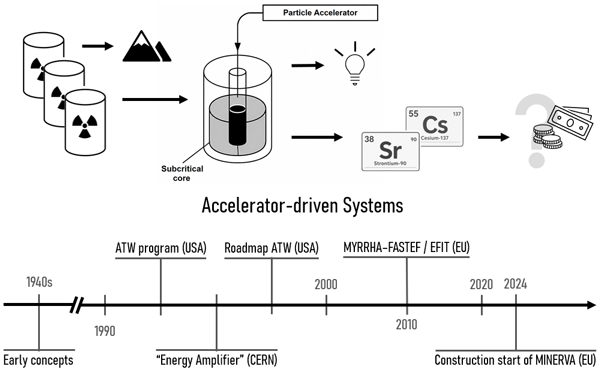
The long history of promises by accelerator-driven systems
Friederike Frieß
Björn Steigerwald
Yannick Vogt
The use of accelerator-driven systems (ADSs) for transmuting high-level radioactive waste has attracted renewed attention, spurred in part by startups. In such systems, selected radionuclides are converted into other (radio)nuclides through nuclear reactions, particularly fission. ADSs couple an external neutron source to a subcritical reactor, offering greater flexibility in fuel composition compared to critical reactors. Although the idea dates back several decades, no systems have yet been implemented.
We argue that the core technological concept remains largely unchanged from earlier proposals and therefore inherits many of the same challenges – notably high costs and engineering complexity. We examine the potential role of radioisotope production as an additional revenue stream beyond electricity generation and waste incineration in more detail. We find that the projected contribution of radioisotope production to the overall economics of ADS facilities is highly sensitive to assumptions about market size, price stability, and deployment scale.
- Article
(766 KB) - Full-text XML
- BibTeX
- EndNote


“Electricity is but the fleeting byproduct from nuclear reactors. The actual product is forever deadly radioactive waste” is a frequently cited statement by Michael Keegan from the Coalition for a Nuclear-Free Great Lakes in Canada (NIRS, 2026). While the term “forever” is subject to interpretation, it is widely acknowledged that high-level radioactive waste must be managed over unprecedented time spans. Despite broad consensus among scientists and practitioners that deep geological repositories represent the most viable option for final disposal, progress in their implementation has been slow. To date, only Finland has entered the trial operation phase of a deep geological repository for spent nuclear fuel (Kraev, 2025).
Against this background, the concept of partitioning and transmutation (P&T; see Appendix A for abbreviations) has repeatedly gained attention in the context of radioactive waste management. The approach is based on separating spent nuclear fuel into different material streams (partitioning), enabling the recycling of fissile and fertile materials while reducing the inventory of selected long-lived radionuclides – primarily minor actinides – through irradiation (transmutation). This is generally expected to reduce the long-term radiotoxicity of the remaining material for final disposal. However, despite several decades of research and development, industrial-scale implementation of P&T fuel cycles has not yet been realized.
Within the range of proposed transmutation technologies, accelerator-driven systems (ADSs) are often considered to be the most flexible option. Compared to critical fast reactors that might also be used for transmutation, they offer safety benefits at the cost of less net electricity production. They consist of a subcritical core that multiplies neutrons supplied by an external source, typically generated via spallation reactions driven by a particle accelerator. A schematic overview of an ADS is shown in Fig. 1. The main safety advantage of an ADS is that the core remains subcritical: it only multiplies the neutrons supplied by the external source and cannot sustain a chain reaction. The neutron population in the core is therefore controlled by the strength of the external source, which can be rapidly reduced or stopped by shutting down the particle accelerator. This subcritical configuration enables the use of fuels with comparatively high minor actinide fractions (up to ≈45.7 % in some design studies (Artioli et al., 2008)), whereas in critical reactors the fraction is usually limited to a few percent due to safety and feedback constraints. More details on this and the overall transmutation process can be found in Frieß et al. (2021).
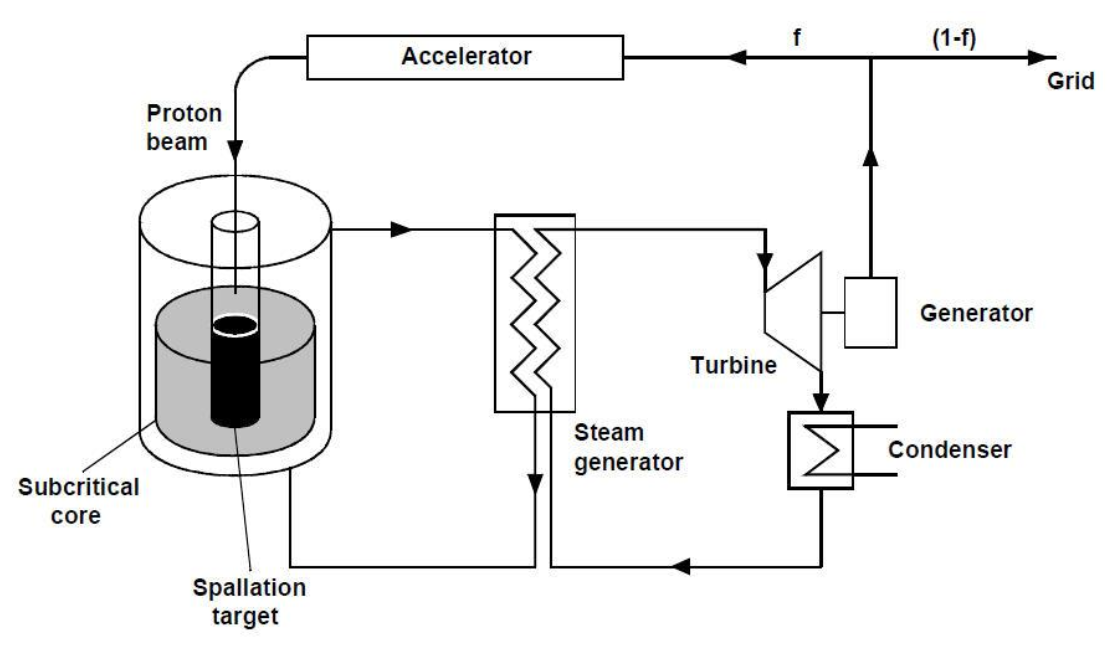
Figure 1Schematic of an accelerator-driven system (ADS). Particles from a particle accelerator strike a spallation target (black), producing neutrons that multiply in the subcritical nuclear reactor core (gray). The thermal power produced in the subcritical core and spallation target is removed by the primary coolant and transferred, via a steam generator, to a secondary loop and then converted into electricity through a turbine-generator set. A fraction of the electricity f is used to operate the facility, especially the accelerator. The remaining electricity is exported to the grid. Figure source: Xenofontos (2018).
While ADSs have been extensively studied from a technical perspective, fewer studies systematically examined the persistence of underlying design assumptions, e.g., the benefit of minor actinide reduction in nuclear waste, and the robustness of associated economic claims.
We argue that current ADS concepts do not constitute a fundamentally new technological solution but largely reproduce design principles and system assumptions that have been discussed for decades, together with their associated challenges. Building on a historical overview and an assessment of the current state of development, we identify key technical and systemic constraints that remain unresolved.
Furthermore, we assess recent efforts to broaden the value proposition of ADS by incorporating additional revenue streams beyond electricity generation and waste transmutation. Using radionuclide production in a specific design as a case study, we evaluate the credibility of such claims and their potential contribution to the overall economic viability of ADS facilities.
The basic technical parts of ADSs – high-energy proton accelerators, spallation targets to produce neutrons, and subcritical multiplying assemblies – were developed separately.
Already in 1940, possible ways of particle acceleration had been demonstrated (Bryant, 1992). The idea of coupling particle accelerators to subcritical assemblies emerged at Livermore National Laboratory and Chalk River Laboratory shortly after World War II (Lucia and Grisolia, 2024). The goal was the production of fissile material using neutrons generated from a spallation source. This option drove research in the following decades (Pistner et al., 2024).
An interest in ADSs for energy production and waste transmutation increased in the late 1980s and early 1990s, also because of growing public opposition against nuclear waste disposal sites (NEA, 2002; Ramana, 2018). The large-scale projects OMEGA in Japan and CAPRA/CADRA in France started (NEA, 2002; Kawarada, 1992; IAEA, 2004).
In the US, the idea of using an accelerator-driven neutron source for commercial nuclear energy production and transmutation of fission products and actinides was pushed (Bowman et al., 1992; Jameson et al., 1992). The US Department of Energy funded the Accelerator Transmutation of Waste (ATW) program starting in the mid-1990s (Arthur, 1992). This program examined high-current linear accelerators (typically 1 GeV, 10–30 mA) coupled to subcritical systems optimized for transmutation of minor actinides and selected long-lived fission products (Beller et al., 2001). The work, including experimental R&D, continued, even though, in 1996, the National Academy of Sciences already stated that “none of the dose reductions seem large enough to warrant the expense and additional operational risk of transmutation” (NRC, Committee on Separations Technology and Transmutation Systems, 1996).
Nevertheless, work continued for a couple of years. Bowman (1998)'s review provided one of the first systematic quantitative assessments of ADSs for nuclear waste transmutation, comparing thermal and fast ADS cores and establishing reference ranges for subcritical multiplication factors (keff≈0.95–0.98) and achievable actinide destruction rates under various fuel cycle assumptions (Bowman, 1998). The US Department of Energy published a “Roadmap for Developing Accelerator Transmutation of Waste (ATW) Technology” in 1999 (DoE, 1999). This roadmap suggested USD 10 billion for one demonstrator facility and a time period of more than 100 years. Funding declined in the following years (Kirchner et al., 2015).
Meanwhile, Rubbia et al. (1995) proposed the Energy Amplifier (EA), a fast-spectrum, lead- or lead–bismuth-cooled subcritical reactor driven by a 1 GeV proton beam with currents on the order of 10 mA (Carminati et al., 1993; Rubbia et al., 1995). The fast spectrum was chosen to improve transmutation efficiency and to enhance fuel utilization through the breeding of additional fissile material. One of the claimed features of the EA was that criticality accidents, one major cause of nuclear accidents and much more likely in fast neutron spectra, would be suppressed (Rubbia et al., 1995).
Later, detailed system studies indicated that limited actinide recycling in thermal reactors provides only a comparatively small benefit for repository utilization. A quantitative assessment for the US Yucca Mountain reference repository showed that limited recycling of plutonium and minor actinides in pressurized water reactors increases the allowable repository loading by only about a factor of 2 compared to once-through disposal (Wigeland et al., 2007).
The EA and ATW concepts triggered a series of international scenario analyses by the International Atomic Energy Agency (IAEA) and OECD Nuclear Energy Agency (NEA), which formalized ADS terminology and compared ADS-based transmutation strategies with once-through and fast-reactor-based closed fuel cycles (NEA, 2006, 2002; IAEA, 2004, 1998). These studies generally position ADSs as dedicated burner systems within broader P&T strategies rather than stand-alone power technologies (NEA, 2006, 2002; IAEA, 2004, 1998). They indicated that recycling and fissioning all plutonium can reduce the long-term radiotoxicity of high-level waste by about an order of magnitude relative to once-through operation and that additional efficient burning of minor actinides in fast-spectrum systems (including ADSs) could, in principle, further reduce long-term radiotoxicity and decay heat by factors exceeding 100, provided very high overall destruction fractions and separation efficiencies are achieved (Salvatores, 2005). Some of those studies also mention the relevance of fission products.
Europe emerged as a focal region for ADS development, with the Belgian MYRRHA concept as the most advanced example. Initially conceived as a 40 MWth experimental facility driven by a 350 MeV, 5 mA proton accelerator, MYRRHA evolved into a lead–bismuth eutectic-cooled fast-spectrum ADS with a 600 MeV, up to 4 mA linac (2.4 MW beam power), designed as a multipurpose research facility for material irradiation, fuel testing, ADS dynamics experiments, and transmutation studies (Abderrahim et al., 2001; Bruyn et al., 2015). Within the EU's 6th and 7th Framework Programmes (2002–2013), two reference designs building on MYRRHA were developed: the MYRRHA-FASTEF core as an experimental demonstrator and the EFIT (European Facility for Industrial Transmutation) as a conceptual 400 MWth industrial ADS dedicated to minor actinide transmutation (Artioli et al., 2008; Mansani et al., 2012; Sarotto et al., 2013). None of these systems has been realized so far. Even though one of MYRRHA's stated applications is nuclear waste treatment, it should be noted that this does not refer to the actual treatment of radioactive waste. One purpose of MYRRHA is to conduct experiments using fuel with high minor actinide content. Most of the reactor elements use once-recycled mixed-oxide (MOX) fuel (Sarotto et al., 2013).
Taken together, this historical development (Fig. 2) suggests a considerable degree of continuity in the technical approach of spent-fuel waste management. While design details and intended applications have evolved over time, the most widely discussed approach to transmutation of radioactive waste is the use of fast, sub-critical reactors. Challenges such as material endurance and separation efficiencies already identified in the early studies have not been solved yet and still shape research efforts.
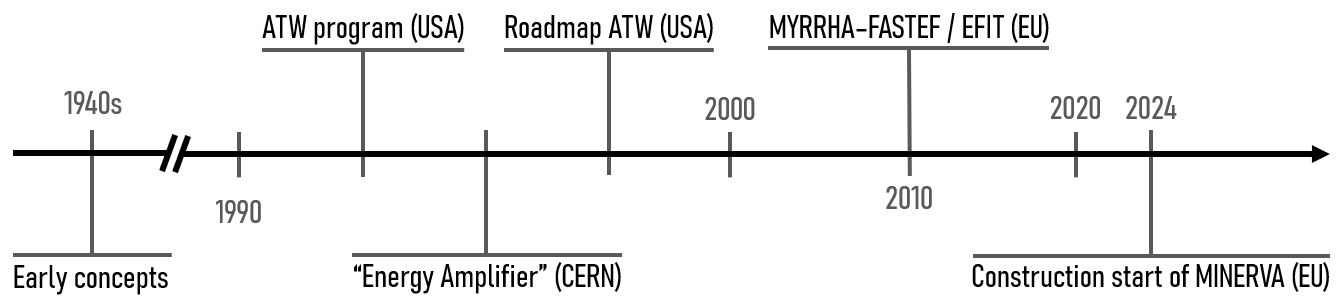
Figure 2Timeline showing the evolution of accelerator-driven systems (ADSs). In the 1940s, basic concepts of ADSs were demonstrated. In the 1990s, the USA developed the Accelerator Transmutation of Waste (ATW) program, and a corresponding roadmap was published, while, at CERN, the Energy Amplifier (EA) was proposed, shifting from thermal to fast-neutron-spectrum reactors. Since the new millennium, European projects like MYRRHA and EFIT have emerged, leading to the start of construction of MYRRHA's first accelerator–target phase, MINERVA.
There are several approaches to assessing a technology's readiness for deployment. The most widely used is the technology readiness level (TRL), originally developed by NASA. Pistner et al. (2024) discuss the limitation of this approach and its applicability to nuclear systems in detail. In their study, ADSs are assessed as being in the “applied research” phase: key components (high-current accelerators, megawatt spallation targets, fast cores, advanced fuels) have been demonstrated individually but not yet as a fully integrated, industrial-scale power or transmutation plant able to actually transmute relevant parts of spent fuel (Pistner et al., 2024; Abderrahim and Giot, 2021). Existing spallation neutron sources for research operate at a maximum level of a few MW and validate spallation target concepts. Industrial ADS transmuters would require neutron sources in the 10–20 MW range and long-term, high-availability operation that has not yet been demonstrated in an integrated ADS configuration (Pistner et al., 2024). To date, no prototype ADS has operated anywhere in the world, and development remains limited to research facilities, experimental setups, and conceptual designs rather than integrated industrial-scale systems.
A broad portfolio of low- and medium-power ADS-related experiments (FEAT, TARC, MUSE, YALINA, MEGAPIE, TEF-P, etc.) has provided data on source-driven reactor physics and target behavior, while industrial-scale concepts such as EFIT (400 MWth) remain at the conceptual-study level and have not progressed to licensing or construction (Pistner et al., 2024). MYRRHA (Belgium), a multi-purpose research facility, not a commercial plant, is the most advanced ADS project worldwide. The construction of MINERVA, the first phase of the MYRRHA ADS project, started in 2024 and is currently planned to be commissioned in 2036 (myrrha aisbl/ivzw, 2026a). Accelerator reliability is identified as a central technical bottleneck. For MYRRHA, safety and availability requirements limit beam interruptions longer than 3 s to less than 10 times per 90 d operating cycle (Vandeplassche, 2011). An increased frequency or duration of beam interruptions would impose high thermal stress on core components, resulting in greater maintenance demands. Such performance levels have not yet been demonstrated in an integrated ADS environment (Pistner et al., 2024; Abderrahim and Giot, 2021).
Other countries such as China and Japan are conducting limited research on ADSs (Kurata et al., 2002; Yan et al., 2017; Wang et al., 2016; Sasa, 2015; Liu et al., 2025; Fu et al., 2025; Liu et al., 2025, 2024). All of these projects are in the applied-research stage at best (Yee-Rendón, 2022). Overall, current activities remain focused on component validation, experimental facilities, and conceptual design studies rather than on prototype operation or industrial deployment. The exception to that is concepts brought forward by startups, namely Transmutex and Emerald Horizon (Houben et al., 2025; Mueller, 2024).
Already in 1996, it was stated that P&T cannot “eliminate” the need for a final repository for high-level radioactive waste (NRC, Committee on Separations Technology and Transmutation Systems, 1996). The assessment of transmutation systems is therefore not only a question of the theoretical performance of an irradiation facility but also of system-level constraints across the entire fuel cycle. One example is the so-called last-core problem, describing a case of a country not having sufficient supply of spent nuclear fuel to add the needed amount of fresh fissile material to fuel fabrication. Every irradiation in the core reduces the fraction of fissile material in the fuel. Consequently, new fissile nuclides must be added to the next irradiation cycle.
In this context, it is important to distinguish between theoretical radiotoxicity reduction potentials and repository-relevant performance indicators. Repository capacity is typically constrained by factors such as decay heat and waste volume rather than by radiotoxicity metrics alone. This is also acknowledged by proponents of P&T systems (Abderrahim and Giot, 2021). This is particularly relevant for fuels with high transuranic contents, as considered in ADS concepts, which are associated with higher decay heat and may therefore affect repository design and capacity constraints.
Partitioning and transmutation do not eliminate the need for geological disposal, nor do they fundamentally alter repository design requirements under limited recycling schemes. The final generation of recycled fuel, in which transuranic elements are concentrated, must be disposed of as well – thereby possibly offsetting the gains achieved through process waste separation.
Several studies were published at the end of the 1990s that assessed systems for transmutation more critically (Liebert et al., 1999; Husson and de Montgolfier, 1999; Birraux, 1997). These studies identified significant challenges and development risks. Among the well-known and, to date, unresolved issues is the problem of proliferation. As already mentioned above, the origin of ADSs lies in the motivation to produce fissile materials. Many high-energy accelerators were further developed in US weapon laboratories after the end of the Cold War (Frieß and Liebert, 2018). But the more important proliferation risk is the fact that almost every implementation of a transmutation fuel cycle requires separating the fissile material from the spent fuel, thereby removing the radiation barrier that provides self-protection and makes the material difficult to handle.
Another crucial aspect that remains unclear is whether the required separation efficiencies can be achieved. For example, in 1998, the IAEA assumed a separation factor of 1:10 000 (corresponding to a separation efficiency of 99.99 %) (IAEA, 1998). The separation efficiency is crucial for the overall efficiency of the transmutation system: the losses during each cycle accumulate in the material that needs to be sent to final disposal.
Assuming 10 recycling steps in a transmutation scenario and a continuous supply of spent fuel entering the separation facility, even with a separation efficiency of 99.99 % per step, about 0.1 % of the initial inventory of the target radionuclides would enter the waste stream.
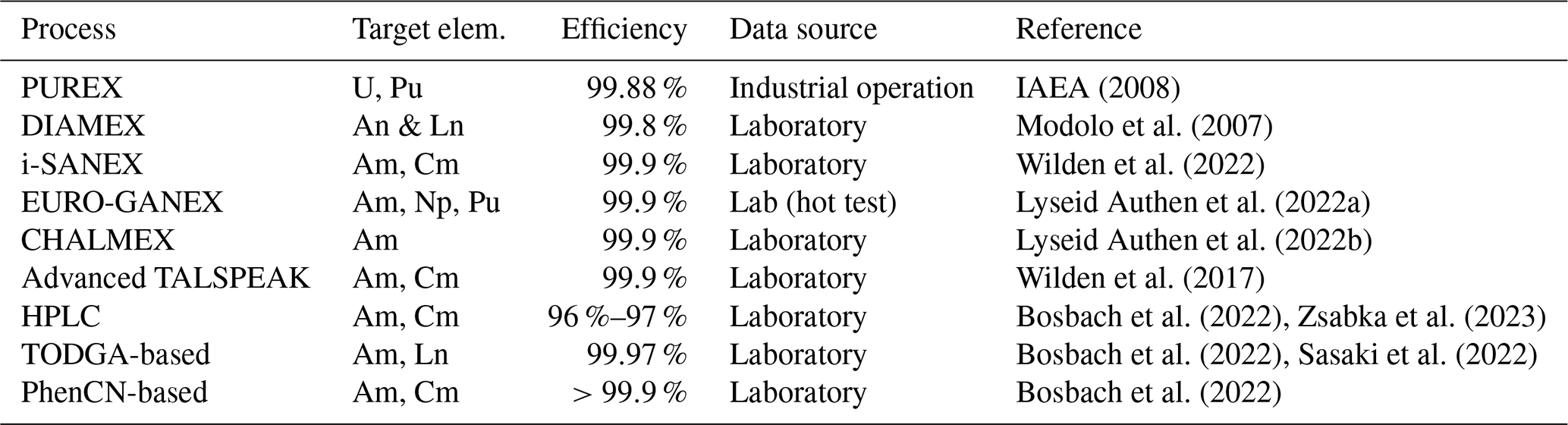
An OECD/NEA Study of 2018 showed only limited progress on the availability of processes for spent-fuel treatment ending in separated material streams (NEA, 2018). Today, as summarized in Table 1, the efficiencies envisaged for potential transmutation scenarios have not yet been achieved at the laboratory scale. With an efficiency of 99.9 %, as reached by most laboratory processes, losses in the separation step already amount to approximately 1 % of the initial inventory. This must be considered in relation to the tonne-scale initial inventory as even 1 % represents a significant quantity of material. The claims made almost 30 years ago have not materialized, while, at the same time, many analyses still use very favorable separation efficiencies.
IAEA (2008)Modolo et al. (2007)Wilden et al. (2022)Lyseid Authen et al. (2022a)Lyseid Authen et al. (2022b)Wilden et al. (2017)Bosbach et al. (2022)Zsabka et al. (2023)Bosbach et al. (2022)Sasaki et al. (2022)Bosbach et al. (2022)Table 1State of the art in separation efficiency. The listed efficiencies should be seen in relation to the assumed value of 99.99 % in IAEA (1998).
Other development risks include achieving sufficient accelerator availability in continuous operation, demonstrating the safe operation of metal-cooled subcritical systems, and the practical feasibility of the spallation targets, e.g., survivability of beam windows (Englert et al., 2024; Frieß et al., 2021).
Even if these technological challenges are resolved, the question of the benefit of minor actinide transmutation remains open. While early concepts considered the transmutation of both minor actinides and certain fission products, more recent proposals tend to focus on minor actinides. This is sometimes justified by the claim that minor actinides are especially relevant to assessing the hazard of a final repository, in contrast to the relevance of fission products when assessing risk (Stanculescu, 2013). However, it is precisely this risk – and thus the long-lived fission products – that is most pertinent to the safety assessment of a final repository (Schmidt et al., 2013). Fission products are much more mobile and are thus more likely to travel to Earth's surface instead of staying confined in the deep geological repository.
The focus on minor actinide reduction via fission leads to an increased production of long-lived fission products in the final waste stream (Frieß and Liebert, 2018, 2022). This aspect is not captured when considering radiotoxicity alone. Nevertheless, Council Regulation (Euratom) 2025/1304 explicitly identifies “radioactive waste minimization and reducing the radiotoxicity of this waste” (EU, 2025) as eligible areas for funding. This wording highlights a comparatively tractable technical objective, but it should not obscure other dimensions of radioactive waste disposal. These include the financial and energy costs of operating ADS facilities, reprocessing plants, and transmutation target fabrication facilities over many decades, as well as the secondary waste streams generated by these processes.
Bowman et al. (1992) made “waste transmutation” a prominent part of their design. This idea persisted, even though the potential benefit for the final disposal of high-level radioactive waste has been continuously questioned in the literature (NRC, Committee on Separations Technology and Transmutation Systems, 1996; Frieß et al., 2021; Schmidt et al., 2013). The main motivation for Rubbia and his colleagues in proposing their concept of an ADS, dubbed “Energy Amplifier” (EA), was to design a system for energy production (Rubbia et al., 1995; Carminati et al., 1993).
Producing electricity using nuclear power plants is generally associated with relatively high costs compared to other forms of electricity generation: “The prospects for the expansion of nuclear energy remain decidedly dim in many parts of the world. The fundamental problem is cost” was stated in an influential MIT study (Buongiorno et al., 2018). This did not change, even if storage as needed by volatile renewables is taken into account (Lazard, 2025; CSIRO, 2024). Nuclear projects in western countries are typically only bankable if governments provide financial risk mitigation or support mechanisms (Weibezahn and Steigerwald, 2024).
This issue becomes more pronounced when considering fast ADSs: metal-cooled fast reactors, which are the design of (almost) all sub-critical reactor cores, are estimated to be about 20 %–40 % more expensive than light–water reactors (Mooz and Siegel, 1979). The Russian sodium-cooled fast reactor BN-800 had 20 % higher cost than the – also Russian – light–water reactor VVER-1200 (WNA, 2021).
Studies on the economics of the back-end of the nuclear fuel cycle indicate that fast reactors represent one of the more costly options considered (NEA, 2013). Exact cost estimates remain difficult due to the limited number of fast reactors in operation (Braun, 2012). In addition, the particle accelerator represents a substantial cost component (Rubens, 2024). Its size, which is a major driver of cost, is determined by the required particle energy (Kirchner et al., 2015). Consequently, developers are exploring additional revenue streams by expanding the range of potential products. One declared option is the production of radioisotopes.
More recent designs, such as the ADES facility promoted by Emerald Horizon propose the provision of process heat for hydrogen production in addition to electricity generation while aiming to avoid the production of transuranic waste (Mueller, 2024). The START facility from Transmutex offers not only transmutation of already existing high-level radioactive waste but also process heat, district heating, and radioisotope production (Houben et al., 2025). The similarity of these concepts to earlier designs is not coincidental: Federico Carminati, who was part of the team developing the EA, is the founder of Transmutex.
Radionuclides have various applications in medicine, industry, and research. In medicine, they are central to diagnostic nuclear imaging (e.g., single-photon emission computed tomography (SPECT) using technetium-99m and positron emission tomography (PET) using positron emitters such as fluorine-18) and to targeted radiopharmaceutical therapies, where radioactive compounds deliver cytotoxic radiation to tumors while enabling patient-specific dosimetry and treatment planning (NEA, 2019; IAEA, 2020).
In industry, radionuclide sources are widely used for non-destructive testing and process control, such as industrial radiography to inspect welds and castings; gauging devices to measure thickness, density, or fill levels; and well logging to characterize subsurface formations as penetrating radiation can probe sealed systems where optical or mechanical sensing is impractical (Moussa et al., 2025; Pant et al., 2022).
In research and academia, radionuclides function as tracers to quantify transport, mixing, residence times, and reaction pathways in complex systems, supporting both laboratory experiments and field studies across chemistry, biology, environmental science, and engineering (Moussa et al., 2025; IAEA, 2020).
There are several established production routes for radionuclides, including target irradiation in reactors or accelerators; radionuclide generators; and, for some fission products, recovery from irradiated fuel or reprocessing-derived waste streams (Wang et al., 2022; Chukhlantseva et al., 2024).
Examples of radioisotopes that are produced by irradiation are lutetium-177, which is used in targeted radionuclide therapy, and molybdenum-99/technetium-99m for nuclear imaging. Technetium-99m has a half-life of 6 h, which makes direct transport over longer distances highly challenging. Therefore, a so-called “technetium-99m-generator” is supplied, in which molybdenum-99, with a half-life of 66 h, serves as a parent nuclide. Lutetium-177 has a half-life of 6.6 d.
These physical decay properties illustrate the limitations on transport and, consequently, on market structure. In addition, these materials are subject to strict transport regulations while simultaneously having to meet pharmaceutical quality standards.
The second means of production is the separation of radioisotopes produced during the nuclear fission process from irradiated nuclear fuel. Examples are caesium-137 and strontium-90. These isotopes are generated by the fission of fissile material during reactor operation. While both power and research reactors produce such isotopes, commercially relevant quantities are obtained primarily through the reprocessing of spent power reactor fuel. Separating them from irradiated fuel requires facilities capable of handling highly radioactive material (Logunov et al., 2026; EPA, 2026).
Consequently, the number of suppliers is limited, and those are located in countries with large-scale nuclear programs. This results in a geographically concentrated supply structure and potential geopolitical dependencies.
Strontium-90 is primarily used in industrial applications such as thickness gauges and calibration devices while also serving niche functions in medicine and research (Pant et al., 2022; Salem and Thurston, 2006; Chakravarty, 2012). Its half-life of approximately 29 years makes it suitable for long-term applications and international trade. However, as a high-activity radioactive source, its production, transport, and disposal are subject to stringent regulatory control under international radiation protection and nuclear security frameworks, and price transparency is limited compared to conventional commodities (IAEA, 2018). The global market for strontium-90 is estimated to range between USD 10–200 million, with projected growth to USD 12–250 million by 2032. Estimates vary substantially depending on methodology and data availability (24chemicalResearch, 2025; Intel Market Research, 2025; Synorah Systems, 2026). Purity levels and chemical form vary according to application requirements. Based on available estimates, reported prices range between USD 10 000–50 000 per GBq (24chemicalResearch, 2025; Intel Market Research, 2025).
Radionuclides produced by irradiation do not necessarily have to be produced in a nuclear research reactor; alternative production routes, such as cyclotrons, are also available. Nevertheless, the prospect of generating revenue and thereby reducing the burden on public finances is frequently cited as a justification for incorporating radioisotope production into research reactors (NEA, 2019; European Commission, Joint Research Centre, 2021; Krásny and Belko, 2025).
The research reactor FRM-II in Munich, Germany, was also presented as a facility for isotope production (Gerstenberg and Waschkowski, 1997; Axmann et al., 1997). It provides radioisotopes for diagnostics and therapy and is considered to contribute to mitigating supply shortages in Europe (ENS, 2022).
The BR2 research reactor in Mol, Belgium, supplies medical isotopes to the market, and its successor MYRRHA is also intended to do so (myrrha aisbl/ivzw, 2026b). Originally oriented as a commercial project, it is argued that the shift towards a transmutation facility was driven in part by the aim of scaling up the project and aligning it with the European research landscape (Brookhuis, 2023).
The Belgian government announced in 2018 that it would cover 40 % of the costs (Dalton, 2018); 6 years later, work on the first phase of MYRRHA started (WNN, 2024). Commissioning of user facilities is now planned to start in 2030 (SCK CEN, 2026). As of 2026, the project continues to “seek international partners and investors” for the following phases, implying that financing is not secured (myrrha aisbl/ivzw, 2026c).
Currently, the High-Flux Reactor (HFR) in Petten, Netherlands, with a thermal power of 45 MW, supplies approximately 60 % of Europe's and 30 % of the world's medical radioisotopes. This aging reactor is intended to be replaced by the 55 MWth PALLAS reactor, which aims to “secure the global production of medical isotopes” (NRG PALLAS, 2026b). Originally planned to be commercially financed, the project is now substantially supported by public funds (NRG PALLAS, 2026a).
The Transmutex START plant, currently under design, primarily aims to transform nuclear waste but is also intended to generate revenue through the sale of radionuclides. While MYRRHA and PALLAS primarily emphasize irradiation-based isotope production, the START concept additionally relies on the separation of fission products from existing streams. In 2025, a detailed study of the concept, including a business case, was published. The study outlines multiple projected revenue streams and concludes that the facility could operate on a commercial basis even under a conservative scenario (Houben et al., 2025).
These projects illustrate a broader pattern in which isotope production is framed not only as a scientific objective but also as a revenue-generating component of large-scale nuclear infrastructure investments. But, in the end, they all rely on public funding. In the following, we examine the estimated income from this revenue stream as presented by Transmutex for its START facility.
Transmutex plans to separate caesium-137 and strontium-90 from spent nuclear fuel for commercial application, including potential medical use (Houben et al., 2025). In addition, radionuclides such as lutetium-177, molybdenum-99/technetium-99m, terbium-149, actinium-224, plutonium-238, and gadolinium-148 are projected to be produced via irradiation of specific targets (Houben et al., 2025).
The estimated turnover for irradiation-produced radionuclides is summarized in Table 22 in Houben et al. (2025). For three isotopes, no price data are provided due to limited market transparency (Houben et al., 2025).
Reported price estimates per GBq are based on email communication with private suppliers; it remains unclear whether these represent buyer or seller prices. Using the values provided, the combined annual turnover for lutetium-177, molybdenum-99/technetium-99m and actinium-225 amounts to less than EUR 15 000 (for the other radionuclides, no values are given). This corresponds to well below 0.1 % of projected annual facility revenue and is therefore economically negligible at the facility scale. Given the regulatory and pharmaceutical quality requirements associated with medical radionuclides (e.g., purity and quality assurance), additional investments will probably be needed. Then, the estimated revenues will be even smaller compared to the overall costs of the facilities.
In one scenario analyzed in the study, total facility turnover is projected to be between EUR 250–850 million over the reactor lifetime (Houben et al., 2025). This lower revenue trajectory reflects the absence of electricity sales and more conservative assumptions regarding isotope monetization and energy vector revenues. However, even under these assumptions, irradiation-based radionuclide production does not materially affect total revenue (Houben et al., 2025). In contrast, radionuclides recovered via reprocessing, notably strontium-90, constitute a major component in both scenarios.
The projected annual turnover of EUR 50–200 million therefore implies that a single facility would account for a substantial share of current global strontium-90 market volumes (NEA, 2019). The economic viability of this revenue stream is consequently highly sensitive to assumptions regarding market absorption and long-term price stability. The financial model used by Houben et al. (2025) treats price assumptions as exogenous and does not explicitly account for potential price adjustments resulting from increased supply.
Houben et al. (2025) further restrict their analysis to a single-facility reactor site. The scenarios, therefore, do not constitute a system-wide assessment of a transparent, reproducible nationwide system description for the treatment of the full German high-level waste inventory (HLW). Additionally, key modeling parameters and interim results are only partly documented. Additional scenario analysis has been conducted by Englert et al. (2026), which suggests that, under more conservative assumptions regarding transmutation efficiency and inventory constraints, multiple reactors would be required to process the German transuranium inventory.
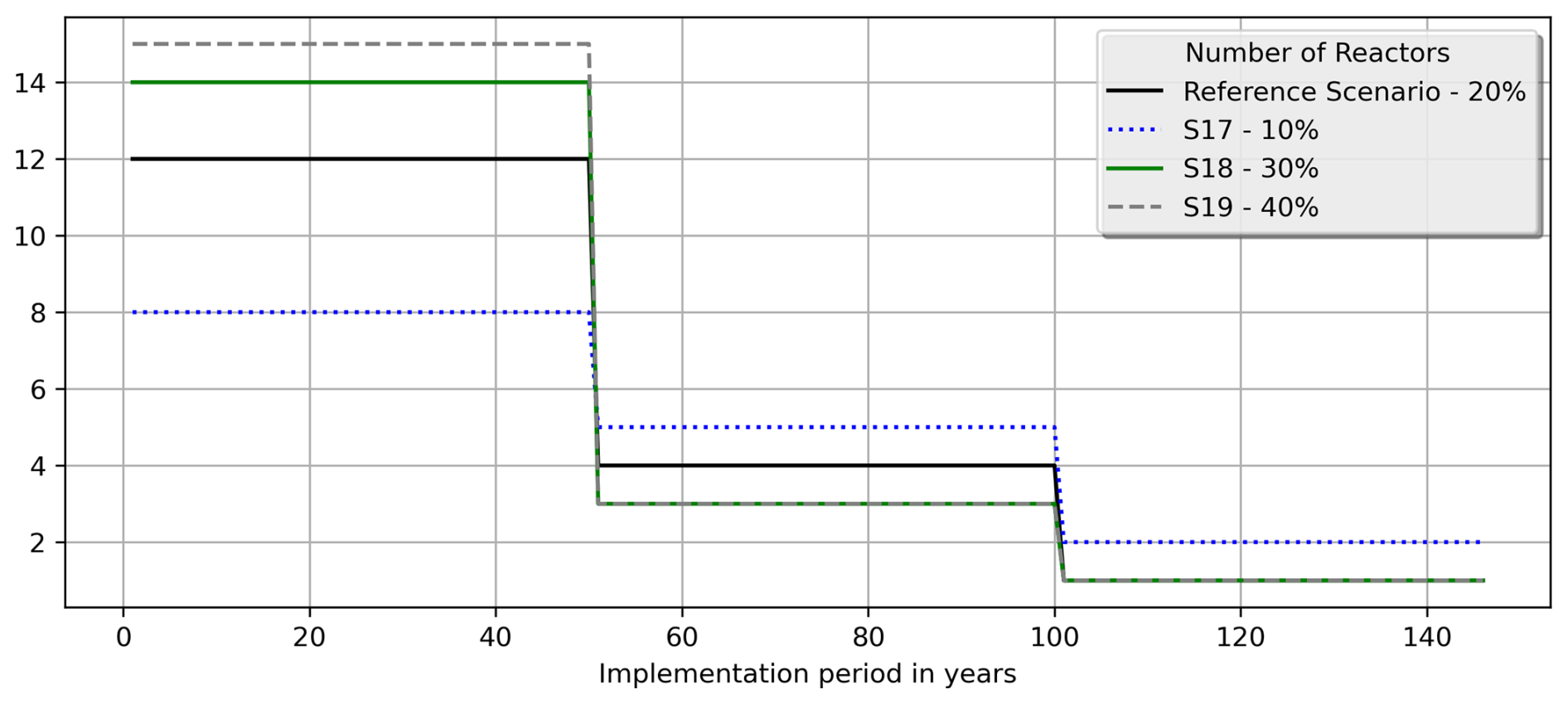
Figure 3Number of sub-critical reactors in transmutation scenarios for different transmutation fractions. Reactor lifetime is 50 years. The graph ends as soon the scenario with the shortest implementation period reaches the cut-off criterion. Other scenarios may last for several hundred years. The figure is taken from Englert et al. (2026). In this report, more than 20 scenarios were evaluated to assess the influence of different parameters. Scenarios S17, S18, and S19 show the influence of different transmutation efficiencies (10 %, 30 %, and 40 %, respectively) on the reactor numbers if all other parameters, e.g., target reduction or separation efficiency, stay the same.
One key outcome of those nationwide scenarios is the number of reactors actually needed. This number is highly dependent on the boundary conditions used in the scenario analysis. In particular, assumptions regarding transmutation efficiency significantly affect the required reactor fleet size. While parts of Houben et al. (2025) refer to efficiencies of approximately 40 %, other sections implicitly assume complete transmutation. To assess the impact of the transmutation efficiency, a parameter study was conducted (Englert et al., 2026). Figure 3 presents the number of START reactors required to cover the total German TRU inventory for different transmutation efficiency assumptions. These scenarios assume continuous full-capacity operation over a 50-year lifetime, except for the final unit in the phase-out period. The authors do not explicitly consider it to be the case that the reprocessing units are designed to serve four reactors each. But this actually means that it would be more economical to have reactor numbers in increments of four operating.
What is evident from the scenarios is the following: in the first phase of a potential P&T program using the START reactor, there would be around 10 facilities operating. As discussed above, even one facility generates a significant share of the global market for strontium-90, which is seen as a potential revenue stream. It is unlikely that the projected revenues would be fully realized if additional facilities were deployed.
“Forty years of complex research and development has [sic] shown that ADS could provide a solution to the challenge posed by spent nuclear fuels” states Hamid Ait Abderrahim, the General Manager of the MYRRHA INP, and his colleague Michel Giot (Abderrahim and Giot, 2021).
ADSs represent a highly complex technology. In particular, within partitioning and transmutation (P&T) fuel cycles, not only must reactor operation be reliably controlled but advanced reprocessing and fuel fabrication technologies are also required. Given the current state of science and technology, it remains uncertain whether all of the necessary components can be developed to industrial maturity.
Even if one assumes that the required technologies could be made available, the question of overall benefit remains open. Various metrics exist for assessing radioactive waste; while they do not necessarily contradict one another, each addresses only specific aspects of waste management and disposal. Comprehensive, system-level assessments remain limited. Those studies would not only outline the full-scale infrastructure needed to treat a given inventory but also systematically evaluate the implications for final repositories.
This uncertainty regarding the overall effectiveness of transmutation is reflected in the trend of assigning an increasing number of additional applications to transmutation facilities in order to enhance their attractiveness. One frequently cited example is the production of radioisotopes for potential revenue generation.
As illustrated by the example of the START facility by Transmutex, the promise of generating income through the production of radioisotopes is unlikely to be realized at a scale that materially affects overall facility economics. Claims of substantial economic returns from radioisotope production should therefore be treated with caution.
More generally, it is notable that the idea of a simple technological solution to the radioactive waste problem repeatedly re-emerges, often with only minor modifications. At the same time, progress in the search for and operation of final repositories for radioactive waste continues to be slow. This contrast underscores the need for a careful and critical assessment of proposals that present themselves as straightforward or comprehensive remedies to a fundamentally complex challenge.
| ADS | Accelerator-driven system |
| ATW | Accelerator-driven transmutation of waste |
| EA | Energy Amplifier |
| IAEA | International Atomic Energy Agency |
| MA | Minor actinides (mainly neptunium, americium, curium) |
| P&T | Partitioning and transmutation |
FF: analysis, drafting, research design, revision, supervision. BS: analysis, drafting. YV: analysis.
No data sets were used in this article.
The contact author has declared that none of the authors has any competing interests.
Publisher's note: Copernicus Publications remains neutral with regard to jurisdictional claims made in the text, published maps, institutional affiliations, or any other geographical representation in this paper. The authors bear the ultimate responsibility for providing appropriate place names. Views expressed in the text are those of the authors and do not necessarily reflect the views of the publisher.
This article is part of the special issue “Time as a safety factor: opportunities and challenges of timely nuclear waste disposal”. It is a result of the “3rd Interdisciplinary Research Symposium on the Safety of Nuclear Disposal Practices (safeND)”, Berlin, Germany, 17–19 September 2025.
We are grateful to Wolfgang Liebert for reading an early draft; his decades of experience in the field offered valuable insights. The authors prepared the original draft, with generative AI being used solely to refine the initial grammar and style. The authors take full responsibility for the content.
This paper was edited by Carlo Dietl and reviewed by three anonymous referees.
24chemicalResearch: Global Strontium-90 Market Research Report, Outlook and Forecast 2025-2032, https://www.24chemicalresearch.com/download-sample/294983/strontium-90-market (last access: 27 March 2026), 2025. a, b
Abderrahim, H. A. and Giot, M.: The Accelerator Driven Systems, a 21st Century Option for Closing Nuclear Fuel Cycles and Transmuting Minor Actinides, Sustainability, 13, 12643, https://doi.org/10.3390/su132212643, 2021. a, b, c, d
Abderrahim, H. A., Kupschus, P., Malambu, E., Benoit, P., Van Tichelen, K., Arien, B., Vermeersch, F., D’hondt, P., Jongen, Y., Ternier, S., and Vandeplassche, D.: MYRRHA: A multipurpose accelerator driven system for research & development, Nuclear Instruments and Methods in Physics Research Section A: Accelerators, Spectrometers, Detectors and Associated Equipment, 463, 487–494, https://doi.org/10.1016/S0168-9002(01)00164-4, 2001. a
Arthur, E.: The Los Alamos Accelerator Transmutation of Nuclear Waste (ATW) Concept, LA-UR-92-2020, Tech. rep., Los Alamos National Laboratory, 1992. a
Artioli, C., Chen, X.-N., Gabrielli, F., Glinatsis, G., Liu, P., Maschek, W., Petrovich, C., Rineiski, A., Sarotto, M., and Schikorr, M.: Minor Actinide Transmutation in ADS: The EFIT Core Design, International Conference on the Physics of Reactors 2008, PHYSOR 08, 3, 2101–2109, 2008. a, b
Axmann, A., Böning, K., and Rottmann, M.: FRM-II: The new German research reactor, Nucl. Eng. Des., 178, 127–133, https://doi.org/10.1016/S0029-5493(97)00215-X, 1997. a
Beller, D. E., Van Tuyle, G. J., Bennett, D., Lawrence, G., Thomas, K., Pasamehmetoglu, K., Li, N., Hill, D., Laidler, J., and Fink, P.: The U.S. accelerator transmutation of waste program, Nuclear Instruments and Methods in Physics Research Section A: Accelerators, Spectrometers, Detectors and Associated Equipment, 463, 468–486, https://doi.org/10.1016/S0168-9002(01)00163-2, 2001. a
Birraux, C.: Contrôle de la sûreté et de la sécurité des installations nucléaires. Tome I: Conclusions du rapporteur, Tech. Rep. 349, Office Parlementaire d’Evaluation des Choix Scientifiques et Technologiques, Assemblée Nationale, 1997. a
Bosbach, D., Modolo, G., and Tromm, W.: Partitioning and Efficient Transmutation, Studie mit Fokus auf innovativen Strategien in RUSsland (PETRUS), Report for the federal ministry for the environment, climate action, nature conservation and nuclear safety, Research Centre Jülich and Karlsruhe Institute of Technology, 2022. a, b, c
Bowman, C. D.: Accelerator Driven Systems for Nuclear Waste Transmutation, Annu. Rev. Nucl. Part. S., 48, 505–556, https://doi.org/10.1146/annurev.nucl.48.1.505, 1998. a, b
Bowman, C. D., Arthur, E. D., Lisowski, P. W., Lawrence, G. P., Jensen, R. J., Anderson, J. L., Blind, B., Cappiello, M., Davidson, J. W., England, T. R., Engel, L. N., Haight, R. C., Hughes, H. G., Ireland, J. R., Krakowski, R. A., LaBauve, R. J., Letellier, B. C., Perry, R. T., Russell, G. J., Staudhammer, K. P., Versamis, G., and Wilson, W. B.: Nuclear energy generation and waste transmutation using an accelerator-driven intense thermal neutron source, Nuclear Instruments and Methods in Physics Research Section A: Accelerators, Spectrometers, Detectors and Associated Equipment, 320, 336–367, https://doi.org/10.1016/0168-9002(92)90795-6, 1992. a, b
Braun, C.: Economic Analysis of Fast Spectrum Reactors, in: Fast Spectrum Reactors, edited by: Waltar, A. E., Todd, D. R., and Tsvetkov, P. V., 39–46, Springer US, Boston, MA, ISBN 978-1-4419-9571-1 978-1-4419-9572-8, https://doi.org/10.1007/978-1-4419-9572-8_3, 2012. a
Brookhuis, H.: Making Belgian Big Science, Hist. Stud. Nat. Sci., 53, 35–70, https://doi.org/10.1525/hsns.2023.53.1.35, 2023. a
Bruyn, D. D., Abderrahim, H. A., Baeten, P., and Leysen, P.: The MYRRHA ADS Project in Belgium Enters the Front End Engineering Phase, Phys. Proced., 66, 75–84, https://doi.org/10.1016/j.phpro.2015.05.012, 2015. a
Bryant, P. J.: A Brief History and Review of Accelerators, CERN Accelerator School: Course on General Accelerator Physics, CERN, Jyvaskala, Finland, 1992. a
Buongiorno, J., Corradini, M., Parson, J., and Petti, D.: The Future of Nuclear Energy in a Carbon-Constrained World, Tech. rep., MIT Energy Initiative, 2018. a
Carminati, F., Klapisch, R., Revol, I. P., Roche, C., Rubiol, A., and Rubbia, C.: An Energy Amplifier for Cleaner and Inexhaustible Nuclear Energy Production Driven by a Particle Beam Accelerator, CERN/AT/93 47 (ET), European Organisation for Nuclear Research, 1993. a, b
Chakravarty, R.: Availability of Yttrium-90 from Strontium-90: A Nuclear Medicine Perspective, Cancer Biotherapy & Radiopharmaceuticals, 27, 165–176, https://doi.org/10.1089/cbr.2012.1285, 2012. a
Chukhlantseva, E. V., Stepanova, O. V., Dichenko, O. Y., Kutuzova, O. A., Dzhevello, K. A., Tatarnikova, Y. M., Demchenko, E. A., and Borisenko, V. P.: Determination of the Radionuclide Composition of the Cesium–Strontium Fraction of High-Level Waste from Spent Nuclear Fuel Reprocessing, Radiochemistry, 66, 890–900, https://doi.org/10.1134/S1066362224060146, 2024. a
CSIRO: GenCost2024-25, Tech. rep., Australia's National Science Academy, https://www.csiro.au/en/research/technology-space/energy/Electricity-transition/GenCost (last access: 10 August 2026), 2024. a
Dalton, D.: Belgium confirms € 558 Million in Funding for Myrrha Research Reactor, Nucnet, https://www.nucnet.org/news/belgium-confirms-558-million-in-funding-for-myrrha-research-reactor (last access: 27 March 2026), 2018. a
DoE: A Roadmap for Developing Accelerator Transmutation of Waste (ATW) Technology – Report to Congress, DoE/RW-0519, U.S. Department of Energy, 1999. a
Englert, M., Mohr, S., Chaudry, S., Kurth, S., and Krob, F.: Verfolgung und Aufbereitung des Standes von Wissenschaft und Technik bei alternativen Entsorgungsoptionen für hochradioaktive Abfälle (altEr), Report for the Federal Office for the Safety of Nuclear Waste Management, urn:nbn:de:0221-2024052844041, Öko-Institut e.V., 2024. a
Englert, M., Pistner, C., Vogt, Y., and Frieß, F.: Scenario Analysis for Partitioning and Transmutation (P&T) in a Phase-out Scenario, INRAG working paper, International Nuclear Risk Assessment Group (INRAG), https://www.inrag.org/wp-content/uploads/2026/04/inrag_put_publication_V4.pdf (last access: 10 August 2026), 2026. a, b, c
ENS: Medical Isotopes – International Experts Call For Action To Secure Supply, European Nuclear Society, https://www.euronuclear.org/news/medical-isotopes-challenges-opportunities-sustainable-supply/ (last access: 27 March 2026), 2022. a
EPA: Radionuclide Basics: Strontium-90, https://www.epa.gov/radiation/radionuclide-basics-strontium-90 (last access: 6 July 2026), 2026. a
EU: Annex to the Proposal for a Council Regulation establishing the research and training programme of the European Atomic Energy Community for the period 2028-2032, complementing Horizon Europe, the Framework Programme for Research and Innovation, and providing for the Community’s contribution to the ITER project, and repealing Regulation (Euratom) 2025/1304, https://eur-lex.europa.eu/legal-content/EN/TXT/?uri=CELEX%3A52025PC0594 (last access: 10 August 2026), 2025. a
European Commission, Joint Research Centre: Study on the Sustainable and Resilient Supply of Medical Radioisotopes in the EU, Tech. rep., Publications Office of the European Union, Luxembourg, https://publications.jrc.ec.europa.eu/repository/handle/JRC124565 (last access: 10 August 2026), 2021. a
Frieß, F. and Liebert, W.: Entschärfung der Atommüllproblematik durch Partitionierung und Transmutation? Beiträge zur Einschätzung des Potentials, in: “Grand Challenges” meistern: Der Beitrag der Technikfolgenabschätzung, edited by: Decker, M., Lindner, R., Lingner, S., Scherz, C., and Sotoudeh, M., no. 20 in Gesellschaft Technik Umwelt, 420, Nomos, Baden-Baden, ISBN 978-3-8487-4057-4, 2018. a, b
Frieß, F. and Liebert, W.: Inert-Matrix Fuel for Transmutation: Selected Mid- and Long-Term Effects on Reprocessing, Fuel Fabrication and Inventory Sent to Final Disposal, Prog. Nucl. Energ., 145, 104106, https://doi.org/10.1016/j.pnucene.2021.104106, tex.ids= FRIE2022104106, 2022. a
Frieß, F., Arnold, N., Liebert, W., and Müllner, N.: Sicherheitstechnische Analyse und Risikobewertung von Konzepten zu Partitionierungs- und Transmutationsanlagen für hochradioaktive Abfälle, Report for the Federal Office for the Safety of Nuclear Waste Management, urn:nbn:de:0221-2021030826033 BASE-002/21, Institute of Safety and Risk Sciences, BOKU University Vienna, Berlin, 2021. a, b, c
Fu, X., Liu, Y., Zhou, H.-Y., Wang, C.-Z., Xiu, T.-Y., Xiao, Z., Tang, H.-B., Huang, Z.-W., Zhou, Z.-H., Yuan, L.-Y., Yan, Z.-Y., and Shi, W.-Q.: New clicked hydrophobic 2,9-bis-triazolyl-1,10-phenanthroline ligands used as extractants for actinide/lanthanide separation: Towards deep purification, J. Hazard. Mater., 495, 139085, https://doi.org/10.1016/j.jhazmat.2025.139085, 2025. a
Gerstenberg, H. and Waschkowski, W.: FRM-II. A new reactor also for isotope production, Tech. rep., Australian Nuclear Association Inc., 1997. a
Houben, G., Esen, S., Groska, J., Stromer, F., and Andernat, M.: Umsetzungsstudie über eine beschleunigergetriebene Neutronenquelle am Standort eines ehemaligen Kernkraftwerks zwecks Produktion von Krebsmedikamenten, Fernwärme und geothermischer Energie sowie zur Entsorgung hochradioaktiver Abfälle, Tech. rep., Bundesagentur für Sprunginnovation, 2025. a, b, c, d, e, f, g, h, i, j, k, l
Husson, J.-P. and de Montgolfier, P.: A Nuclear Amplifier for Energy for Electricity Production, Tech. rep., Essor Europe, Paris, France, 1999. a
IAEA: Accelerator Driven Systems: Energy Generation and Transmutation of Nuclear Waste, IAEA-TECDOC-985, International Atomic Energy Agency, Vienna, Austria, 1998. a, b, c, d
IAEA: Implications of Partitioning and Transmutation, Technical Reports Series No. 435, International Atomic Energy Agency, Vienna, 2004. a, b, c
IAEA: Spent Fuel Reprocessing Options, IAEA-TECDOC-1587, International Atomic Energy Agency, Vienna, Austria, 2008. a
IAEA: Code of Conduct on the Safety and Security of Radioactive Sources, Iaea/codeoc/2004, rev. 2018, International Atomic Energy Agency, Vienna, Austria, 2018. a
IAEA: Nuclear Medicine Resources Manual: 2020 Edition, Human health series no. 37, International Atomic Energy Agency, Vienna, Austria, 2020. a, b
Intel Market Research: Strontium-90 Market Growth Analysis, Market Dynamics, Key Players and Innovations, Outlook and Forecast 2025–2032, Imr-4332, https://www.intelmarketresearch.com/strontium-2025-2032-839-4332 (last access: 10 August 2026), 2025. a, b
Jameson, R., Lawrence, G., and Bowman, C.: Accelerator-Driven Transmutation Technology for Incinerating Radioactive Waste and for Advanced Application to Power Production, Nuclear Instruments and Methods in Physics Research Section B: Beam Interactions with Materials and Atoms, 68, 474–480, https://doi.org/10/bxfjgx, 1992. a
Kawarada, S.: The OMEGA Programme in Japan: A Base for International Cooperation, IAEA Bulletin, 3, 35–37, 1992. a
Kirchner, G., Englert, M., Pistner, C., Kallenbach-Herbert, B., and Neles, J.: Gutachten “Transmutation”, Gutachten für die kommission lagerung hoch radioaktiver abfälle, K-MAT 48, Öko-Institut e.V., Zentrum für Naturwissenschaft und Friedensforschung Universität Hamburg, Darmstadt/Hamburg, 2015. a, b
Kraev, K.: Finland completes key trial for world's first deep geological nuclear waste repository, https://www.nucnet.org/news/finland-completes-key-trial-for-world-s-first-deep-geological-nuclear-waste-repository-3-2-2025 (last access: 10 August 2026), 2025. a
Krásny, P. and Belko, B.: On LVR-15 Radioisotope Production Capabilities, Ann. Nucl. Energ., 214, 111184, https://doi.org/10.1016/j.anucene.2025.111184, 2025. a
Kurata, Y., Takizuka, T., Osugi, T., and Takano, H.: The accelerator driven system strategy in Japan, J. Nucl. Mater., 301, 1–7, https://doi.org/10.1016/S0022-3115(01)00731-0, 2002. a
Lazard: Lazard Levelized Cost of Energy +, Tech. rep., https://www.lazard.com/media/eijnqja3/lazards-lcoeplus-june-2025.pdf (last access: 10 August 2026), 2025. a
Liebert, W., Bähr, R., Glaser, A., Hahn, L., and Pistner, C.: Fortgeschrittene Nuklearsysteme, Review Studie für den Schweizer Wissenschaftsrat, Technology Assessment TA 34/1999, IANUS, TU Darmstadt, 1999. a
Liu, B., Guo, X., Zhang, X., Liu, T., Lyu, X., Liu, F., and Han, R.: Electron accelerator driven subcritical system loaded with spent nuclear fuel, Radiat. Phys. Chem., 233, 112753, https://doi.org/10.1016/j.radphyschem.2025.112753, 2025. a
Liu, Y., Sakasai, K., Sekiguti, T., Ilo, M., Suzuki, J., Yee-Rendon, B., and Nakamura, H.: J-Parc, Annual report, J-Parc, 2024. a
Logunov, M. V., Kozlov, P. V., Voroshilov, Y. A., Yumaguen, A. Z., Markov, D. V., I., S. A., and Tananaev, I. G.: Technologies for Recovering Valuable Elements from the Waste Generated and Stored at the Mayak Production Association, Radiochemistry, 68, 99–121, https://doi.org/10.1134/S1066362226020013, 2026. a
Lucia, U. and Grisolia, G.: Energy Amplifier Systems as Sustainable Nuclear Reactors: An Overview, Sustainability, 16, 2743, https://doi.org/10.3390/su16072743, 2024. a
Lyseid Authen, T., Adnet, J.-M., Bourg, S., Carrott, M., Ekberg, C., Galán, H., Geist, A., Guilbaud, P., Miguirditchian, M., Modolo, G., Rhodes, C., Wilden, A., and Taylor, R.: An overview of solvent extraction processes developed in Europe for advanced nuclear fuel recycling, Part 2 – homogeneous recycling, Sep. Sci. Technol., 57, 1724–1744, https://doi.org/10.1080/01496395.2021.2001531, 2022a. a
Lyseid Authen, T., Wilden, A., Schneider, D., Kreft, F., Modolo, G., StJ Foreman, M. R., and Ekberg, C.: Batch flowsheet test for a GANEX-type process: the CHALMEX FS-13 process, Solvent Extr. Ion Exc., 40, 189–202, https://doi.org/10.1080/07366299.2021.1890372, 2022b. a
Mansani, L., Artioli, C., Schikorr, M., Rimpault, G., Angulo, C., and Bruyn, D. D.: The European Lead-Cooled EFIT Plant: An Industrial-Scale Accelerator-Driven System for Minor Actinide Transmutation, Nucl. Technol., 180, 241–263, https://doi.org/10/ggkx83, 2012. a
Modolo, G., Vijgen, H., Serrano‐Purroy, D., Christiansen, B., Malmbeck, R., Sorel, C., and Baron, P.: DIAMEX Counter‐Current Extraction Process for Recovery of Trivalent Actinides from Simulated High Active Concentrate, Sep. Sci. Technol., 42, 439–452, https://doi.org/10.1080/01496390601120763, 2007. a
Mooz, W. E. and Siegel, S.: A comparisoin of the capital costs of light water reactor and liquid metal fast breeder reactor power plants, Tech. Rep. R-2441-ACDA, RAND, Santa Monica, CA, 1979. a
Moussa, J. R., Harmon, D., and Rane, S.: Industrial Radiography: Trends, Market Drivers, and Alternatives to Gamma-based Devices, Health Phys., 129, 174–183, https://doi.org/10.1097/HP.0000000000002016, 2025. a, b
Mueller, M. J.: Emerald Horizon: The Future of carbon-free energy supply, https://www.oenb.at/Termine/2024/2024-01-17-energiewende.html (last access: 27 March 2026), 2024. a, b
myrrha aisbl/ivzw: About MYRRHA, https://www.myrrha.be/about-myrrha (last access: 27 March 2026), 2026a. a
myrrha aisbl/ivzw: Nuclear medicine by MYRRHA, https://www.myrrha.be/myrrha-applications/nuclear-medicine-myrrha (last access: 27 March 2026), 2026b. a
myrrha aisbl/ivzw: MYRRHA, https://www.myrrha.be/ (last access: 27 March 2026), 2026c. a
NEA: Accelerator-driven Systems (ADS) and Fast Reactors (FR) in Advanced Nuclear Fuel Cycles, A comparative study, OECD Nuclear Energy Agency, OECD Publishing, Paris, France, ISBN 92-64-18482-1, 2002. a, b, c, d
NEA: Advanced Nuclear Fuel Cycles and Radioactive Waste Management, Tech. rep., OECD Nuclear Energy Agency, OECD Publishing, Paris, France, ISBN 92-64-02485-9, 2006. a, b
NEA: The Economics of the Back End of the Nuclear Fuel Cycle, Nea no. 7061, OECD Nuclear Energy Agency, OECD Publishing, Paris, France, ISBN 978-92-64-20852-0, 2013. a
NEA: State-of-the-art Report on the Progress of Nuclear Fuel Cycle Chemistry, Nuclear Science 7267, OECD Nuclear Energy Agency, OECD Publishing, Paris, France, ISBN 978-92-64-29854-5, https://doi.org/10.1787/9789264298545-en, 2018. a
NEA: The Supply of Medical Isotopes: An Economic Diagnosis and Possible Solutions, Tech. rep., OECD Nuclear Energy Agency, OECD Publishing, Paris, France, https://doi.org/10.1787/9b326195-en, 2019. a, b, c
NIRS: High-Level Radioactive Waste, Nuclear Information and Resource Service, https://www.nirs.org/radioactive-waste/hlw/ (last access: 27 March 2026), 2026. a
NRC, Committee on Separations Technology and Transmutation Systems: Nuclear Wastes: Technologies for Separations and Transmutation, The National Academies Press, http://www.nap.edu/openbook.php?record_id=4912 (last access: 10 August 2026), 1996. a, b, c
NRG PALLAS: About the Programme, https://www.nrgpallas.com/pallas-programme/about-the-programme (last access: 27 March 2026), 2026a. a
NRG PALLAS: PALLAS Programme, https://www.nrgpallas.com/pallas-programme (last access: 27 March 2026), 2026b. a
Pant, H. J., Bhardwaj, Y. K., and Pujari, P. K.: Applications of Radioisotopes and Radiation Technology in Industry: Current Status and Prospects, Current Science, 123, 377–387, https://doi.org/10.18520/cs/v123/i3/377-387, 2022. a, b
Pistner, C., Englert, M., von Hirschhausen, C., Böse, F., Steigerwald, B., and Gast, L.: Analysis and Evaluation of the Development Status, Safety and Regulatory Framework for So-Called Novel Reactor Concepts, Tech. rep., Federal Office for the Safety of Nuclear Waste Management, 2024. a, b, c, d, e, f
Ramana, M. V.: Technical and Social Problems of Nuclear Waste, Wiley Interdisciplinary Reviews: Energy and Environment, 7, https://doi.org/10.1002/wene.289, 2018. a
Rubbia, C., Rubio, J. A., Buono, S., Carminati, F., Fiévet, N., Galvez, J., Gelés, C., Kadi, Y., Klapisch, A., Revol, J.-P., Roche, C., Rynn, K., Sannier, J., and Villard, L.: A Tentative Programme Towards a Full Scale Energy Amplifier, Tech. Rep. CERN/AT/95-44(ET), CERN, Geneva, Switzerland, 1995. a, b, c, d
Rubens, D.: Overview of the MYRRHA/MINERVA Project, Presentation, https://indico.cern.ch/event/1456158/contributions/6130813/attachments/2935418/5155756/2024-09-26 - CERN ZHAW & SCK-CEN Workshop - Overview of the MYRRHA_MINERVA project.pdf (last access: 27 March 2026), 2024. a
Salem, R. and Thurston, K. G.: Radioembolization with Yttrium-90 Microspheres: A State-of-the-Art Brachytherapy Treatment for Primary and Secondary Liver Malignancies, J. Vasc. Interv. Radiol., 17, 1571–1593, https://doi.org/10.1097/01.RVI.0000236744.34720.73, 2006. a
Salvatores, M.: Nuclear fuel cycle strategies including Partitioning and Transmutation, Nucl. Eng. Des., 235, 805–816, https://doi.org/10.1016/j.nucengdes.2004.10.009, 2005. a
Sarotto, M., Castelliti, D., Fernandez, R., Lamberts, D., Malambu, E., Stankovskiy, A., Jaeger, W., Ottolini, M., Martin-Fuertes, F., Sabathé, L., Mansani, L., and Baeten, P.: The MYRRHA-FASTEF Cores Design for Critical and Sub-Critical Operational Modes (EU FP7 Central Design Team Project), Nucl. Eng. Des., 265, 184–200, https://doi.org/10/f5qdtr, 00039, 2013. a, b
Sasa, T.: Design of J-PARC Transmutation Experimental Facility, in: Nuclear Back-end and Transmutation Technology for Waste Disposal, edited by: Nakajima, K., 73–79, Springer Japan, Tokyo, ISBN 978-4-431-55110-2 978-4-431-55111-9, https://doi.org/10.1007/978-4-431-55111-9_8, 2015. a
Sasaki, Y., Kaneko, M., Ban, Y., Matsumiya, M., Nakase, M., and Takeshita, K.: Multi-stage extraction and separation of Ln and An using TODGA and DTBA or DTPA accompanying pH adjustment with lactic acid and ethylenediamine, Sep. Sci. Technol., 57, 2543–2553, https://doi.org/10.1080/01496395.2022.2080707, 2022. a
Schmidt, G., Kirchner, G., and Pistner, C.: Endlagerproblematik - Können Partitionierung und Transmutation helfen?, Technikfolgenabschätzung - Theorie und Praxis, 22, 52–58, 2013. a, b
SCK CEN: MYRRHA Phase 1: MINERVA, https://www.sckcen.be/en/infrastructure/myrrha/myrrha-phase-1-minerva (last access: 27 March 2026), 2026. a
Stanculescu, A.: Accelerator Driven Systems (ADSs) for nuclear transmutation, Ann. Nucl. Energ., 62, 607–612, https://doi.org/10.1016/j.anucene.2013.02.006, 2013. a
Synorah Systems: Strontium-90 Market Size, Revenue, Challenges & Trends, 2026–2033, https://www.linkedin.com/pulse/strontium-90-market-size-revenue-challenges-trends-26-33-b3afc (last access: 1 March 2026), 2026. a
Vandeplassche, D.: Overview of the MYRRHA Project, presentation in Massy-Palaiseau, Paris, France, 26 September, https://indico.cern.ch/event/145066/contributions/173769/ (last access: 10 August 2026), 2011. a
Wang, Y., Chen, D., Dos Santos Augusto, R., Liang, J., Qin, Z., Liu, J., and Liu, Z.: Production Review of Accelerator-Based Medical Isotopes, Molecules, 27, 5294, https://doi.org/10.3390/molecules27165294, 2022. a
Wang, Z.-J., He, Y., Jia, H., Dou, W.-p., Chen, W.-l., Zhang, X., Liu, S.-h., Feng, C., Tao, Y., Wang, W.-s., Wu, J.-q., Zhang, S.-h., and Zhao, H.-W.: Beam commissioning for a superconducting proton linac, Phys. Rev. Accel. Beams, 19, 120101, https://doi.org/10.1103/PhysRevAccelBeams.19.120101, 2016. a
Weibezahn, J. and Steigerwald, B.: Fission for funds: The financing of nuclear power plants, Energy Policy, 195, 114382, https://doi.org/10.1016/j.enpol.2024.114382, 2024. a
Wigeland, R. A., Bauer, T. H., Hill, R. N., and Stillman, J. A.: Impact on Geologic Repository Usage from Limited Actinide Recycle in Pressurized Light Water Reactors, J. Nucl. Sci. Technol., 44, 415–422, https://doi.org/10.1080/18811248.2007.9711303, 2007. a
Wilden, A., Lumetta, G. J., Sadowski, F., Schmidt, H., Schneider, D., Gerdes, M., Law, J. D., Geist, A., Bosbach, D., and Modolo, G.: An Advanced TALSPEAK Concept for Separating Minor Actinides. Part 2. Flowsheet Test with Actinide-spiked Simulant, Solvent Extr. Ion Exc., 35, 396–407, https://doi.org/10.1080/07366299.2017.1368945, 2017. a
Wilden, A., Schneider, D., Paparigas, Z., Henkes, M., Kreft, F., Geist, A., Mossini, E., Macerata, E., Mariani, M., Gullo, M. C., Casnati, A., and Modolo, G.: Selective actinide(III) separation using 2,6-bis[1-(propan-1-ol)-1,2,3-triazol-4-yl]pyridine (PyTri-Diol) in the innovative-SANEX process: laboratory scale counter current centrifugal contactor demonstration, Radiochim. Acta, 110, 515–525, https://doi.org/10.1515/ract-2022-0014, 2022. a
WNA: Fast Neutron Reactors, World Nuclear Association, https://world-nuclear.org/information-library/current-and-future-generation/fast-neutron-reactors (last access: 27 March 2026), 2021. a
WNN: Work starts on first phase of Myrrha, World Nuclear News, https://www.world-nuclear-news.org/articles/work-starts-on-first-phase-of-myrrha (last access: 27 March 2026), 2024. a
Xenofontos, T.: Development of a dynamic stochastic neutronic code for the analysis of conventional and hybrid nuclear reactors, Theses, Université Paris Saclay (COmUE), Université Aristote (Thessalonique, Grèce), https://pastel.hal.science/tel-01865831 (last access: 10 August 2026), 2018. a
Yan, X., Yang, L., Zhang, X., and Zhan, W.: Concept of an Accelerator-Driven Advanced Nuclear Energy System, Energies, 10, 944, https://doi.org/10.3390/en10070944, 2017. a
Yee-Rendón, B.: Overview of ADS Projects in the World, in: Proceedings of the 31st International Linear Accelerator Conference LINAC 2022, edited by: Peter, M., Graeme, B., Robert, A., and Schaa, V. R. W., JACoW Publishing, Geneva, Switzerland, ISBN 978-3-95450-215-8, https://doi.org/10.18429/JACOW-LINAC2022-TU2AA01, 2022. a
Zsabka, P., Wilden, A., Van Hecke, K., Modolo, G., Verwerft, M., and Cardinaels, T.: Beyond U/Pu separation: Separation of americium from the highly active PUREX raffinate, J. Nucl. Mater., 581, 154445, https://doi.org/10.1016/j.jnucmat.2023.154445, 2023. a
- Abstract
- Introduction
- History of ADSs for transmutation
- Current state of development
- Assessment of transmutation systems for waste treatment
- Further motivations for ADS systems
- Production of radionuclides
- Example: estimated revenue from radionuclide production
- Conclusion
- Appendix A: Abbreviations
- Author contributions
- Data availability
- Competing interests
- Disclaimer
- Special issue statement
- Acknowledgements
- Review statement
- References
- Abstract
- Introduction
- History of ADSs for transmutation
- Current state of development
- Assessment of transmutation systems for waste treatment
- Further motivations for ADS systems
- Production of radionuclides
- Example: estimated revenue from radionuclide production
- Conclusion
- Appendix A: Abbreviations
- Author contributions
- Data availability
- Competing interests
- Disclaimer
- Special issue statement
- Acknowledgements
- Review statement
- References