Characterizing the microstructural anisotropy of fine-grained phyllosilicate-rich rocks
Rebecca Kühn
CORRESPONDING AUTHOR
Institut für Geowissenschaften und Geographie, Martin-Luther-Universität, 06120 Halle, Germany
Michael Stipp
Institut für Geowissenschaften und Geographie, Martin-Luther-Universität, 06120 Halle, Germany
Bernd Leiss
Geowissenschaftliches Zentrum Göttingen, Georg-August-Universität, 37077 Göttingen, Germany
Related authors
No articles found.
Muhammad Anees, David Hindle, Ernesto Meneses Rioseco, Jonas Kley, Bernd Leiss, Mumtaz Muhammad Shah, and Javed Akhter Qureshi
EGUsphere, https://doi.org/10.5194/egusphere-2025-5252, https://doi.org/10.5194/egusphere-2025-5252, 2025
This preprint is open for discussion and under review for Solid Earth (SE).
Short summary
Short summary
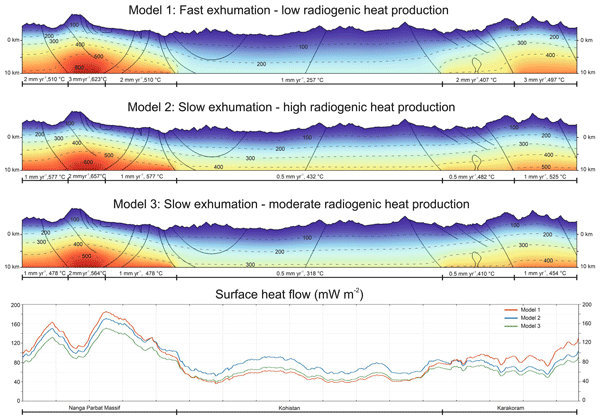
We studied how heat is distributed underground in the western Himalaya to understand its potential for geothermal energy. Using computer models, we show that heat from radioactive rocks, uplift of mountains, and the shape of the land all influence temperatures in the crust. Deep valleys such as the Indus and Hunza may host accessible hot zones, meaning they could be good places to explore for geothermal energy.
Rüdiger Kilian and Michael Stipp
Saf. Nucl. Waste Disposal, 1, 65–66, https://doi.org/10.5194/sand-1-65-2021, https://doi.org/10.5194/sand-1-65-2021, 2021
Ruth Keppler, Roman Vasin, Michael Stipp, Tomás Lokajícek, Matej Petruzálek, and Nikolaus Froitzheim
Solid Earth, 12, 2303–2326, https://doi.org/10.5194/se-12-2303-2021, https://doi.org/10.5194/se-12-2303-2021, 2021
Short summary
Short summary
Rocks in mountain belts have been deformed during continental collision causing a certain alignment of the minerals referred to as crystallographic preferred orientation (CPO). Minerals have anisotropic properties: the velocity of seismic waves travelling through them is direction dependent. This leads to anisotropy of the rocks. We measured the CPO of common rocks within the Alps. With this data and known anisotropic properties of the minerals we calculated the seismic anisotropy of the rocks.
Michael J. Schmidtke, Ruth Keppler, Jacek Kossak-Glowczewski, Nikolaus Froitzheim, and Michael Stipp
Solid Earth, 12, 1801–1828, https://doi.org/10.5194/se-12-1801-2021, https://doi.org/10.5194/se-12-1801-2021, 2021
Short summary
Short summary
Properties of deformed rocks are frequently anisotropic. One of these properties is the travel time of a seismic wave. In this study we measured the seismic anisotropy of different rocks, collected in the Alps. Our results show distinct differences between rocks of oceanic origin and those of continental origin.