
Conference Abstract
| 
06 Sep 2023
Conference Abstract |
| 06 Sep 2023
| 06 Sep 2023
Performance assessment of a generic repository in salt host rock based on Task F of DECOVALEX-2023 – BASE's lessons learnt and future work
Marek Pekala
CORRESPONDING AUTHOR
Federal Office for the Safety of Nuclear Waste Management (BASE), Berlin,
10623, Germany
Carl Rudolf Dietl
Federal Office for the Safety of Nuclear Waste Management (BASE), Berlin,
10623, Germany
Fabiano Magri
Federal Office for the Safety of Nuclear Waste Management (BASE), Berlin,
10623, Germany
Ingo Kock
Federal Office for the Safety of Nuclear Waste Management (BASE), Berlin,
10623, Germany
Related authors
Thimo Philipp and Marek Pekala
Saf. Nucl. Waste Disposal, 2, 189–189, https://doi.org/10.5194/sand-2-189-2023, https://doi.org/10.5194/sand-2-189-2023, 2023
Short summary
Short summary
This workshop aims to bring together experts in both fundamental research on radionuclide chemistry and mobility and its applications to repository safety. It intends to facilitate knowledge exchange between the two fields, promoting more coordinated and goal-oriented safety research.
Ingo Kock, Martin Navarro, Jens Eckel, Stephan Hotzel, and Carlo Dietl
Saf. Nucl. Waste Disposal, 3, 43–47, https://doi.org/10.5194/sand-3-43-2026, https://doi.org/10.5194/sand-3-43-2026, 2026
Short summary
Short summary
In 2021, BASE headed a short workshop called “What do we need to do to trust in models?” at the first edition of the safeND symposium conference (safeND: "Safety of Nuclear Waste Diposal“; Kock et al. 2021). Because of the broad interest people showed in the topic, three consecutive workshops on the topic of “Trust in Models” (TiM) were held between 2022 and 2025. In this Open Letter, we will present the main points of discussion.
Robert James Cuss, Jocelyn Gisiger, Antonio Pio Rinaldi, Elliot James Muir Bird, David Jaeggi, Matthijs Hendrik Nuus, Manuel Lorenzo Sentis, Bastian Johannes Graupner, Frédéric Bernier, Fabien Magri, and Jon Francis Harrington
Saf. Nucl. Waste Disposal Discuss., https://doi.org/10.5194/sand-2026-3, https://doi.org/10.5194/sand-2026-3, 2026
Revised manuscript under review for SaND
Short summary
Short summary
Knowledge of how gas moves through clay-rich rocks and barrier systems in a radioactive waste disposal facility is important to give confidence to long-term containment of waste. The GT experiment was designed to determine the physics driving gas movement in Opalinus Clay, the candidate host rock in Switzerland. The way gas moved through the rock was seen to change based on the rate of gas pressurisation rate – by analogy, the rate of gas production in a geological disposal facility.
Carlo Dietl, Friederike Kelle, and Alexander von Oertzen
Saf. Nucl. Waste Disposal, 2, 255–255, https://doi.org/10.5194/sand-2-255-2023, https://doi.org/10.5194/sand-2-255-2023, 2023
Short summary
Short summary
This abstract describes the scope and the layout of workshop W08 on
Uranium mining – lessons to learn for waste disposal in view of participation and safety.
Thimo Philipp and Marek Pekala
Saf. Nucl. Waste Disposal, 2, 189–189, https://doi.org/10.5194/sand-2-189-2023, https://doi.org/10.5194/sand-2-189-2023, 2023
Short summary
Short summary
This workshop aims to bring together experts in both fundamental research on radionuclide chemistry and mobility and its applications to repository safety. It intends to facilitate knowledge exchange between the two fields, promoting more coordinated and goal-oriented safety research.
Fabien Magri, Ingo Kock, Judith Krohn, Florian Krob, Veronika Ustohalova, Stefan Wittek, and Dimitri Bratzel
Saf. Nucl. Waste Disposal, 2, 139–140, https://doi.org/10.5194/sand-2-139-2023, https://doi.org/10.5194/sand-2-139-2023, 2023
Short summary
Short summary
In this project, an assessment tool is developed to evaluate the applicability of AI methods in geosciences with respect to key geological activities in the site selection process. The results show that AI should not have any decision-making power when used in the site selection process. It is strongly recommended that all methods should be evaluated and validated iteratively and that the results should be made publicly available when applied to the key activities of the site selection process.
Martin Navarro, Ingo Kock, Gerd Frieling, and Thomas Beuth
Saf. Nucl. Waste Disposal, 1, 41–42, https://doi.org/10.5194/sand-1-41-2021, https://doi.org/10.5194/sand-1-41-2021, 2021
Ingo Kock, Michael Jendras, Thorsten Faß, Gerd Frieling, Wolfram Wartenberg, and Karsten Leopold
Saf. Nucl. Waste Disposal, 1, 59–60, https://doi.org/10.5194/sand-1-59-2021, https://doi.org/10.5194/sand-1-59-2021, 2021
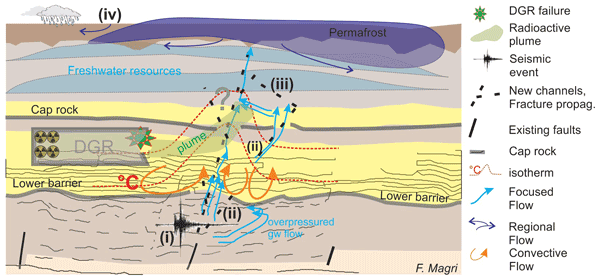
Dominik Kern, Fabien Magri, Victor I. Malkovsky, and Thomas Nagel
Saf. Nucl. Waste Disposal, 1, 179–180, https://doi.org/10.5194/sand-1-179-2021, https://doi.org/10.5194/sand-1-179-2021, 2021
Short summary
Short summary
We try to assess the integrity of storage sites for nuclear waste in case of an earthquake, particularly for sites in crystalline rocks, such as granite.
Ingo Kock, Martin Navarro, Jens Eckel, Carsten Rücker, and Stephan Hotzel
Saf. Nucl. Waste Disposal, 1, 303–303, https://doi.org/10.5194/sand-1-303-2021, https://doi.org/10.5194/sand-1-303-2021, 2021
Short summary
DECOVALEX is an international collaborative project aiming to develop models simulating coupled thermal–hydro–chemical–mechanical processes for use in performance and safety assessment of disposal systems for high-level radioactive waste. BASE actively contributes to Task F, which seeks to build confidence in performance assessment methodologies. This contribution describes recent BASE activities within Task F Salt of DECOVALEX-2023, including lessons learnt and possible future steps.
DECOVALEX is an international collaborative project aiming to develop models simulating coupled...


