
Conference Abstract
| 
06 Sep 2023
Conference Abstract |
| 06 Sep 2023
| 06 Sep 2023
Panel: “novel” nuclear reactors as an alternative disposal option
Matthias Englert
CORRESPONDING AUTHOR
Institute for Applied Ecology, Rheinstr. 95, 64295 Darmstadt, Germany
Friederike Frieß
Institute for Safety and Risk Sciences, University of Natural Resources and Life Sciences (BOKU), Vienna, Austria
Related authors
Matthias Englert and Christoph Pistner
Saf. Nucl. Waste Disposal, 2, 209–209, https://doi.org/10.5194/sand-2-209-2023, https://doi.org/10.5194/sand-2-209-2023, 2023
Short summary
Short summary
Some alternative reactor concepts are frequently discussed in the literature as relevant for the disposal of high-level radioactive waste. We present results on the technological readiness of and research and development on those reactor concepts from a project commissioned by the Federal Office for the Safety of Nuclear Waste Management on novel reactors.
Matthias Englert, Simone Mohr, Saleem Chaudry, and Stephan Kurth
Saf. Nucl. Waste Disposal, 1, 259–260, https://doi.org/10.5194/sand-1-259-2021, https://doi.org/10.5194/sand-1-259-2021, 2021
Friederike Frieß, Björn Steigerwald, and Yannick Vogt
Saf. Nucl. Waste Disposal, 5, 11–23, https://doi.org/10.5194/sand-5-11-2026, https://doi.org/10.5194/sand-5-11-2026, 2026
Short summary
Short summary
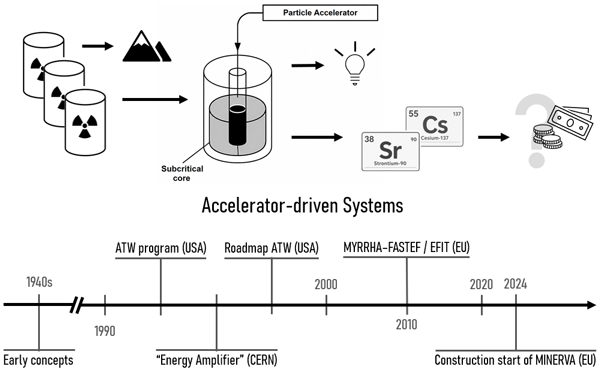
Pretreatment of radioactive waste by partitioning and transmutation (P&T) in accelerator-driven systems (ADSs) has been mentioned as an approach to significantly reduce the requirements and risks associated with a – still necessary – final repository for decades. We show that the technological concept is still very much the same as the one proposed decades ago and discuss possible additional revenue from radioisotope production in transmutation facilities.
Friederike Frieß
Saf. Nucl. Waste Disposal, 2, 211–212, https://doi.org/10.5194/sand-2-211-2023, https://doi.org/10.5194/sand-2-211-2023, 2023
Short summary
Short summary
Several countries consider partitioning and transmutation (P&T) to be a useful supplement to the widely accepted storage of high-level radioactive waste in deep geological disposal. In addition to the technical feasibility, implementation of a P&T fuel cycle poses significant proliferation risks.
Matthias Englert and Christoph Pistner
Saf. Nucl. Waste Disposal, 2, 209–209, https://doi.org/10.5194/sand-2-209-2023, https://doi.org/10.5194/sand-2-209-2023, 2023
Short summary
Short summary
Some alternative reactor concepts are frequently discussed in the literature as relevant for the disposal of high-level radioactive waste. We present results on the technological readiness of and research and development on those reactor concepts from a project commissioned by the Federal Office for the Safety of Nuclear Waste Management on novel reactors.
Friederike Frieß, Wolfgang Liebert, and Nikolaus Müllner
Saf. Nucl. Waste Disposal, 1, 261–262, https://doi.org/10.5194/sand-1-261-2021, https://doi.org/10.5194/sand-1-261-2021, 2021
Matthias Englert, Simone Mohr, Saleem Chaudry, and Stephan Kurth
Saf. Nucl. Waste Disposal, 1, 259–260, https://doi.org/10.5194/sand-1-259-2021, https://doi.org/10.5194/sand-1-259-2021, 2021
Short summary
On a moderated panel, four panelists consider so-called
novelreactor concepts and engage in an interactive discussion with the audience.
On a moderated panel, four panelists consider so-called
novelreactor concepts and engage in an...


